Guide
Corny Keg Sizes and Parts
Dimensions, post standards, lid types, dip tube variants and the complete seal list. The reference nobody else writes.
The short answer
A 5 gallon corny keg is about 25 inches tall and 8.5 inches in diameter, or roughly 27 inches with a ball lock disconnect fitted. Posts come in incompatible ball lock and pin lock standards, and a full seal set is a lid gasket, two post O-rings and two dip tube O-rings.
DisclosureWe earn a commission on qualifying purchases made through links on this page, at no extra cost to you. It does not change what we recommend or how we rank it -- here is how we pick and here is the full disclosure.
Sizes
Dimensions, and the number that actually matters
Common corny keg sizes
| Size | Height | Diameter | Weight full |
|---|---|---|---|
| 2.5 gal | ~18 in | ~8.5 in | ~28 lb |
| 3 gal | ~18-19 in | ~8.5 in | ~33 lb |
| 5 gal (standard) | ~25 in | ~8.5 in | ~55 lb |
| 10 gal | ~25 in | ~11 in | ~100 lb |
The number that matters for a kegerator is not in that table. Fit posts and push ball lock disconnects onto them and a 5 gallon keg’s overall height reaches roughly 27 inches. That is the figure to check against a cabinet’s internal height. Low-profile or right-angle disconnects buy back an inch, which is sometimes the difference between fitting and not.
The 2.5 and 3 gallon sizes are genuinely useful for small batches, for splitting a batch across two yeasts, and for fitting a spare into a full kegerator. Pressure ratings are comparable across sizes.
Posts
Ball lock and pin lock
Two incompatible standards, inherited from the soft drink industry these kegs came from.
Ball lock
- Disconnects push on and lock with a sliding collar.
- Gas and liquid posts are different sizes so you cannot cross them -- gas posts take a 13/16 in socket, liquid posts 11/16 in on most kegs.
- The homebrew default. Nearly every kit sold is ball lock.
Pin lock
- Disconnects twist onto pins.
- Gas posts have two pins, liquid posts three.
- Kegs are slightly shorter and wider than ball lock equivalents, which occasionally helps with cabinet height.
- Turn up cheaply secondhand and are perfectly good -- they simply need pin lock disconnects.
Pick one standard and stay with it. Mixing means two sets of disconnects and a recurring source of confusion in a cold cabinet.
Lids and PRVs
Three variants worth knowing
- Pull-ring PRV. A pressure relief valve you can lift to vent the keg manually. The most useful variant: venting is needed for releasing excess carbonation, purging, and opening a pressurized keg safely.
- Fixed PRV. Relieves automatically at its set point but cannot be operated by hand. Workable; you vent through a gas disconnect instead.
- No PRV. Older lids. Replaceable, and worth replacing -- a keg with no relief path is a keg you cannot vent.
Lids are interchangeable within a keg family, so upgrading an old lid to a pull-ring PRV version is a cheap improvement.
Dip tubes
Three options and when each matters
- Standard liquid dip tube. Reaches almost to the bottom of the keg, so it draws every last drop -- and also all the sediment that settles there.
- Shortened dip tube. Cut down so it sits above the sediment line. Gives clearer early pours and permanently leaves beer behind at the end.
- Floating dip tube. A short tube with a float, so the pickup sits just below the beer surface regardless of level and always draws the clearest beer available. Close to mandatory if you ferment in the keg, and a genuine improvement for serving too.
- Gas dip tube. Very short -- it only needs to reach the headspace. If a keg pours nothing but gas, check that the gas and liquid tubes have not been swapped.
Seals
The complete set, and when to replace it
Five pieces of rubber, and all five are consumables:
- Lid gasket -- the large O-ring around the oval lid.
- Gas post O-ring -- under the post, sealing it to the keg.
- Liquid post O-ring -- same, on the other post.
- Gas dip tube O-ring -- inside the post, sealing the tube.
- Liquid dip tube O-ring -- same, on the liquid side.
Replace the whole set on any used keg before first use, and replace individual pieces whenever a leak test shows bubbles. A complete seal kit is inexpensive and it is the single highest-value thing you can do to a secondhand keg.
Leak testing procedure is in homebrew kegging setup; why homebrewers use these rather than commercial kegs is in corny keg vs commercial keg.
What we recommend
The products on this page
The standard
Entry tier
5 Gallon Ball Lock Corny Keg
AMCYL / NSI
Five gallons, roughly 25 in tall and 8.5 in diameter, ball lock posts, removable oval lid with a pressure relief valve.
Spec sheet
- Capacity
- 5 gal / 19 L
- Height
- ~25 in (26 in with posts)
- Diameter
- ~8.5 in
- Connection
- Ball lock gas and liquid posts
- Pressure rating
- 130 psi typical, 55 psi working
- Lid
- Oval pry-out lid with a PRV
What it is not good at
At 55 lb full it is a two-hand lift. Reconditioned units need a complete seal set before first use.
Who it is for
Any homebrew batch up to 5 gallons
The matching hardware
Mid tier
Complete Homebrew Kegging Starter Kit
Kegco / KOMOS / MoreBeer
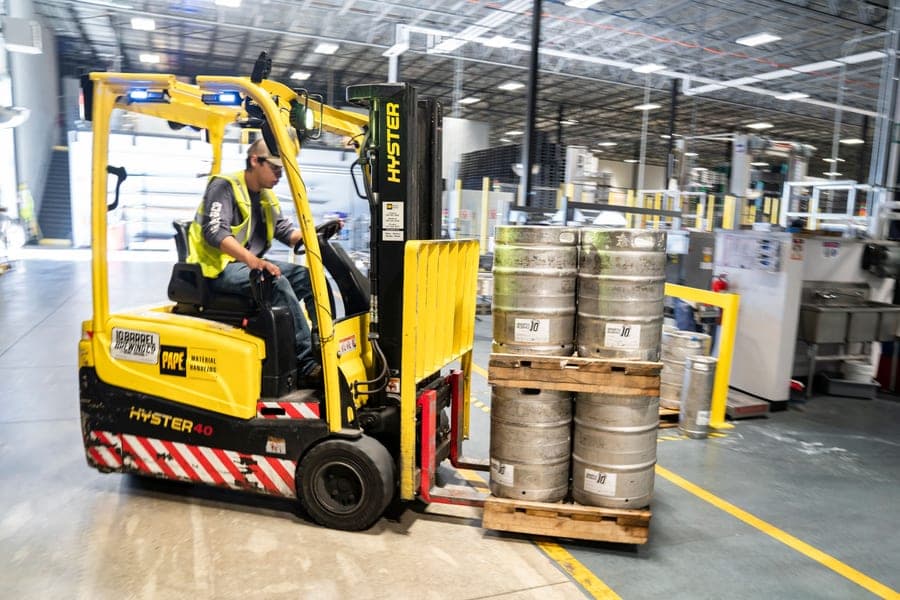
Buying disconnects, lines and a regulator as a matched kit avoids the thread and standard mismatches that plague piecemeal builds.
Spec sheet
- Keg
- One 5 gal ball-lock corny (new or reconditioned)
- Gas
- 5 lb CO2 cylinder (usually empty on arrival)
- Regulator
- Single-body dual-gauge
- Lines
- Gas line, beverage line, disconnects
- Dispense
- Picnic (party) tap on most kits
- Not included
- Cooling -- that is the kegerator decision
What it is not good at
Cylinder usually arrives empty.
Who it is for
Getting disconnects and threads right first time
FAQ
Questions brewers actually ask
What are the dimensions of a 5 gallon corny keg?
Around 25 inches tall and 8.5 inches in diameter, weighing about 55 pounds full. The important figure for kegerator clearance is different: with posts fitted and a ball lock disconnect pushed on, overall height reaches roughly 27 inches. Low-profile or right-angle disconnects recover about an inch of that.
What seals does a corny keg need?
Five: the lid gasket, a gas post O-ring, a liquid post O-ring, a gas dip tube O-ring and a liquid dip tube O-ring. All five are consumables, and replacing the complete set on any used keg before first use is the single highest-value thing you can do to a secondhand keg. Complete seal kits are inexpensive.
How do I tell a ball lock keg from a pin lock keg?
Look at the posts. Ball lock posts are smooth and accept disconnects that push on and lock with a sliding collar, with gas and liquid posts in different sizes. Pin lock posts have pins protruding -- two on the gas post and three on the liquid post -- and accept disconnects that twist on. The two standards are not interchangeable.
What is a floating dip tube and do I need one?
A short liquid dip tube with a float on the end, so the pickup sits just below the beer surface regardless of how full the keg is and always draws the clearest beer available. It is close to mandatory if you ferment in the keg, because a standard dip tube reaches down into the yeast cake, and it noticeably improves early pours even in normal serving use.
Can I replace a corny keg lid?
Yes, lids are interchangeable within a keg family and replacing one is a cheap upgrade. The variant worth having is a lid with a pull-ring pressure relief valve, which lets you vent the keg by hand for purging, releasing excess carbonation, or safely opening a pressurized keg. Older lids with fixed or absent PRVs are worth swapping out.
Why is my keg pouring gas instead of beer?
Most likely the gas and liquid dip tubes have been swapped. The gas dip tube is very short because it only needs to reach the headspace, while the liquid tube reaches near the bottom. If they are in the wrong posts, gas goes into the beer and the liquid line draws from the headspace. Unscrew both posts and check the tube lengths.
Read next
More on kegging
Comparison
Corny Keg vs Commercial Keg
Sizes, fittings and why homebrewers use cornies rather than sanke kegs.
Guide
Homebrew Kegging Setup, Step by Step
The setup order, plus the three day-one failures and how to avoid them.
Roundup
The Best Homebrew Keg Systems
What a kegging kit includes, what it omits, and the complete cost.
Guide
Fermenting in a Keg
The headspace maths, the floating dip tube, and when a real pressure fermenter wins.

Roundup
The Best Beer Line Cleaning Kits
What to buy, how often to clean, and what grows if you do not.
Roundup
The Best Kegerators for Homebrew
Kegerators compared on corny capacity, internal height and temperature range.