Comparison
Corny Keg vs Commercial Keg
Homebrewers use corny kegs for three reasons, and none of them is capacity. Here are the dimensions and the fittings explained.
The short answer
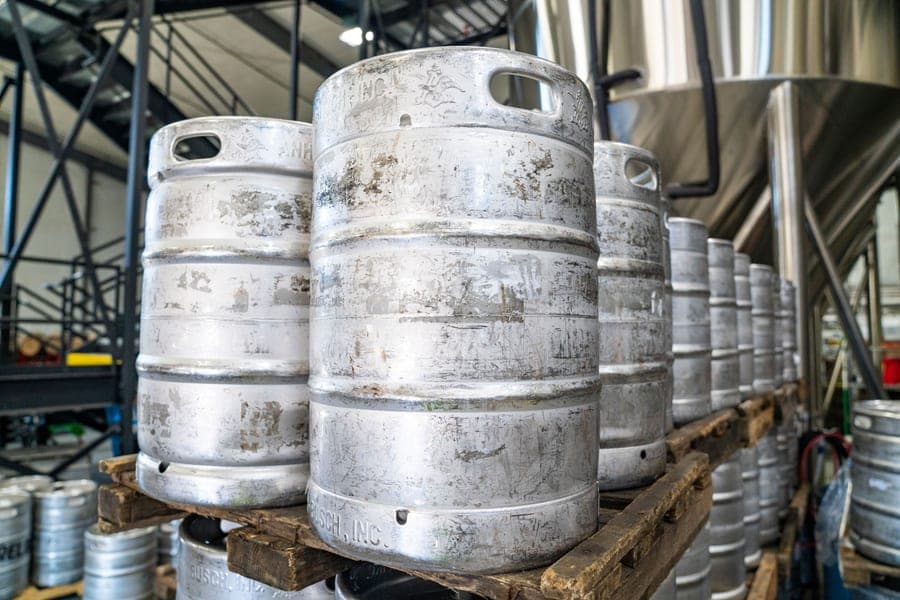
A corny (Cornelius) keg holds 5 gallons, opens with a removable oval lid, and uses ball lock or pin lock quick disconnects. A commercial sanke keg holds 15.5 gallons, has no removable lid, and uses a single coupler. Homebrewers use cornies because they open for cleaning, match batch size and fit a kegerator four at a time.
DisclosureWe earn a commission on qualifying purchases made through links on this page, at no extra cost to you. It does not change what we recommend or how we rank it -- here is how we pick and here is the full disclosure.
Published dimensions and standards
| Corny keg (5 gal) | Sanke half barrel | |
|---|---|---|
| Volume | 5 gal / 19 L | 15.5 gal / 58.7 L |
| Height | ~25 in (26-27 with disconnects) | ~23 in |
| Diameter | ~8.5 in | ~16 in |
| Weight full | ~55 lb | ~160 lb |
| Lid | Removable oval, pry-out | None -- sealed |
| Fittings | Ball lock or pin lock posts | Single sanke coupler |
| Cleaning | Reach inside by hand | Pumped CIP only |
| Pressure rating | ~130 psi burst, 55 psi working | Similar |
| Fits a homebrew batch | Yes, exactly | No, three batches |
An orange rule marks the better of the two on that row.
Why homebrewers use cornies
Three reasons, none of them capacity
The lid comes off. This is the decisive one. A corny keg has an oval pry-out lid large enough to get a hand and a cloth inside, which means you can actually clean and inspect the vessel. A sanke keg is a sealed stainless shell with a single valve, and cleaning one requires a pumped CIP setup that forces cleaner through the valve. For a homebrewer, a vessel you cannot open is a vessel you cannot trust.
It matches the batch. A 5 gallon corny takes a 5 gallon batch, which is what the overwhelming majority of homebrew recipes are written for. A half barrel would need three batches to fill, and a part-full keg of beer under gas is beer you are slowly losing.
Four fit a kegerator. At roughly 8.5 inches in diameter, four cornies occupy about the footprint of one half barrel. That is why kegerators are rated as “one half barrel or four cornies” -- and why four different beers on tap is a realistic home setup.
Fittings
Ball lock and pin lock are not interchangeable
Corny kegs come in two incompatible connection standards, a legacy of the soft drink industry they came from.
- Ball lock. The homebrew default. Disconnects push on and lock with a sliding collar. Gas and liquid posts are different sizes so you cannot cross them. Nearly every kit sold is ball lock.
- Pin lock. Disconnects twist onto pins. Gas posts have two pins, liquid posts three. Pin lock kegs turn up cheaply secondhand, and they are perfectly good -- they just need pin lock disconnects, and the kegs are slightly shorter and wider than ball lock ones.
Pick one standard and stay with it. Mixing means two sets of disconnects and a recurring source of confusion in a cold cabinet.
Buying used
Reconditioned cornies and what to replace
Reconditioned corny kegs are excellent value, because they come out of commercial soft drink service in large numbers. What they also come with is old rubber, and every seal is a potential slow leak that quietly empties your CO2 cylinder.
Replace the whole set before first use: the lid gasket, both post O-rings, and both dip tube O-rings. A complete seal kit is inexpensive and fitting one prevents a frustrating week of leak-hunting. Then pressurize the keg, spray every joint with soapy water, and look for bubbles before you trust it with beer.
Part numbers, dimensions and dip tube variants are all in corny keg sizes and parts. If you want to ferment in one rather than just serve from it, see fermenting in a keg.
Our verdict
Which one should you buy?
Use corny kegs because
5 Gallon Ball Lock Corny Keg
- The lid comes off, so you can clean and inspect it
- Five gallons matches a standard homebrew batch
- Four fit the footprint of one half barrel
- Ball lock disconnects are cheap and universal in homebrewing
What we recommend
The products on this page
The homebrew standard
Entry tier
5 Gallon Ball Lock Corny Keg
AMCYL / NSI
Five gallons, a removable oval lid you can reach into, and ball lock posts. Roughly 25 in tall and 8.5 in diameter, so four fit most full-size kegerators.
Spec sheet
- Capacity
- 5 gal / 19 L
- Height
- ~25 in (26 in with posts)
- Diameter
- ~8.5 in
- Connection
- Ball lock gas and liquid posts
- Pressure rating
- 130 psi typical, 55 psi working
- Lid
- Oval pry-out lid with a PRV
What it is not good at
At 55 lb full it is a two-hand lift. Reconditioned units need a full seal set before first use.
Who it is for
Any homebrew batch of 5 gallons or less
What you need around it
Mid tier
Complete Homebrew Kegging Starter Kit
Kegco / KOMOS / MoreBeer
Disconnects, lines and a regulator matched to the corny standard, which avoids the thread and fitting mismatches that catch piecemeal builds.
Spec sheet
- Keg
- One 5 gal ball-lock corny (new or reconditioned)
- Gas
- 5 lb CO2 cylinder (usually empty on arrival)
- Regulator
- Single-body dual-gauge
- Lines
- Gas line, beverage line, disconnects
- Dispense
- Picnic (party) tap on most kits
- Not included
- Cooling -- that is the kegerator decision
What it is not good at
Cylinder usually arrives empty, and cooling is not included.
Who it is for
Brewers starting from nothing

What they go in
Mid tier
Kegco Full-Size Digital Kegerator
Kegco
Most full-size cabinets rated for a half barrel hold four cornies -- but only if the internal height clears a keg with a disconnect fitted, around 27 in.
Spec sheet
- Keg capacity
- 1 half barrel, or 4 ball-lock corny kegs
- Control
- Digital thermostat
- Temperature range
- Draft serving range
- Taps
- Single, dual and triple configurations sold
- Gas
- CO2 regulator included on most SKUs
- Mobility
- Casters
What it is not good at
Check the internal height specification, not the keg count claim.
Who it is for
Four cornies, or one half barrel
FAQ
Questions brewers actually ask
What size is a corny keg?
Five gallons, or 19 liters. Dimensionally it is around 25 inches tall and 8.5 inches in diameter, though with posts fitted and ball lock disconnects pushed on the assembly reaches roughly 27 inches -- which is the number that matters when checking kegerator clearance. A full one weighs about 55 pounds.
Why do homebrewers use corny kegs instead of commercial kegs?
Mainly because the lid comes off. A corny has an oval pry-out lid big enough to reach a hand and cloth inside, so you can clean and inspect it; a commercial sanke keg is a sealed shell requiring a pumped CIP setup. Cornies also match a standard 5 gallon batch exactly, and four of them fit roughly the footprint of one half barrel in a kegerator.
What is the difference between ball lock and pin lock kegs?
Two incompatible connection standards inherited from the soft drink industry. Ball lock disconnects push on and lock with a sliding collar and are the homebrew default. Pin lock disconnects twist onto pins -- two on the gas post, three on the liquid post -- and those kegs are slightly shorter and wider. Pick one standard and stay with it.
Should I replace the seals on a used corny keg?
Yes, all of them, before first use. Reconditioned kegs come out of commercial service with old lid gaskets, post O-rings and dip tube O-rings, any of which can produce a slow leak that quietly empties your CO2 cylinder. A complete seal kit is inexpensive and fitting one up front saves a week of leak-hunting.
How much pressure can a corny keg hold?
Typical burst ratings are around 130 psi with a working pressure of roughly 55 psi, which is far above anything beer dispensing or pressure fermentation requires. That headroom is why a spare corny makes a legitimate pressure fermenter: fermentation pressures of 10 to 15 psi are well inside the vessel's design envelope.
Read next
More on kegging
Roundup
The Best Homebrew Keg Systems
What a kegging kit includes, what it omits, and the complete cost.
Roundup
The Best Kegerators for Homebrew
Kegerators compared on corny capacity, internal height and temperature range.
Guide
Fermenting in a Keg
The headspace maths, the floating dip tube, and when a real pressure fermenter wins.
Guide
Homebrew Kegging Setup, Step by Step
The setup order, plus the three day-one failures and how to avoid them.